Dental laboratories are under growing pressure to deliver customized work faster while maintaining consistent dimensional accuracy. Digital workflows have become an important part of meeting these demands, and 3D printing now complements scanning, CAD design, and other digital technologies. Among the available technologies, DLP has become particularly relevant for dental production because it can combine detailed resin printing with efficient batch manufacturing. For laboratories evaluating equipment, the right DLP dental 3D printer can therefore influence both production quality and operational efficiency.
DLP Technology Fits the Demands of Digital Dentistry
Digital Light Processing, or DLP, uses projected light to cure photopolymer resin layer by layer. Unlike conventional subtractive production, which removes material from a block, resin 3D printing builds the component according to a digital model. Dental research has found DLP capable of producing clinically acceptable dental models, including at relatively high-speed settings.
This makes DLP particularly attractive for laboratories handling digitally designed models and appliances. A DLP resin 3D printer can translate digital files into physical parts without requiring traditional plaster-model fabrication for every case. The technology can also support different dental applications when paired with appropriate materials, giving labs greater flexibility as their production mix changes.
Precision Matters for Dental Laboratory Production
Accuracy is one of the most important considerations when selecting dental manufacturing equipment. Small dimensional deviations can affect how a printed model interacts with subsequent manufacturing or forming processes. Research comparing technologies has found DLP among the technologies capable of producing accurate full-arch dental models for prosthodontic applications.
However, printer resolution alone does not determine finished-part quality. Resin characteristics, exposure settings, model orientation, structural design, calibration, and post-processing can all influence results. A laboratory therefore benefits from equipment that controls critical printing conditions rather than relying entirely on operator adjustments.
Why a DLP Resin 3D Printer Can Improve Laboratory Efficiency
Production efficiency is another major reason laboratories are adopting resin-based digital manufacturing. Dental businesses often need to process numerous customized cases, making repeatability and predictable throughput important purchasing considerations. The ADA notes that dental 3D printing can help control workflows, improve efficiency, and reduce manufacturing time.
A DLP resin 3D printer can support this workflow by producing multiple digital designs within a production cycle. Applications can include dental models, clear-aligner models, occlusal guards, surgical guides, dentures, try-in dentures, crowns and bridges, veneers, inlays, and onlays, depending on the compatible material and validated workflow.
Environmental Stability Supports More Consistent Results
Resin printing is sensitive to processing conditions, so environmental management can be important for laboratories seeking repeatable output. Temperature and humidity can influence resin behavior, particularly when working with higher-viscosity materials.
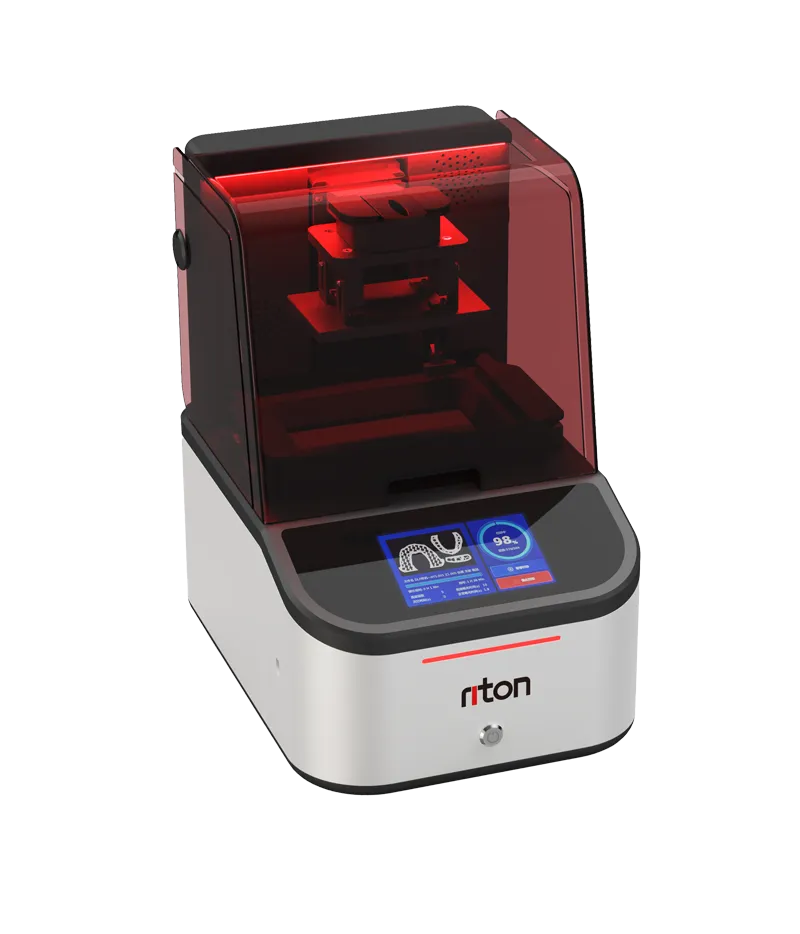
Riton addresses this requirement with the RXDent-D130. According to Riton’s official product information, the printer uses dual heaters and humidity monitoring, with custom heating up to 45°C achieved in five minutes. This environmental control is designed to create more stable printing conditions, particularly when high-viscosity resins are involved.
Riton RXDent-D130 Brings Intelligent Control to Dental Printing
Riton’s RXDent-D130 is a DLP resin 3D printer designed specifically around dental production requirements. Per its official specification sheet, it lists a forming size of 128 × 72 mm with the large resin tank and 60 × 60 mm with the small tank. It uses DLP projection technology, 1920 × 1080 XY resolution, 30 μm XY accuracy, and 405 nm/385 nm light-source wavelengths.
The machine supports layer thicknesses ranging from 10 μm to 200 μm and a printing speed of 1–8 seconds per layer. Riton also equips the RXDent-D130 with automatic light calibration. Its calibration system monitors light intensity and uniformity, with Riton specifying less than ±3% deviation and more than 95% uniformity across the build area.
Another practical feature is force monitoring during the peeling process. The RXDent-D130 tracks peeling force in real time and monitors release-film lifespan, providing alerts intended to help prevent equipment damage and reduce printing failures. For production teams, such monitoring can make maintenance more proactive and reduce unexpected interruptions.
Choosing Equipment Beyond Resolution
For laboratory buyers, selecting a printer should involve more than comparing headline resolution figures. The ADA recommends considering factors such as intended applications, building-platform size, materials, software compatibility, workflow integration, environmental conditions, and automation.
A laboratory should first identify its primary workload and required materials. It can then evaluate whether the printer offers sufficient production capacity, environmental control, monitoring, calibration, and operational flexibility. This approach is more useful than choosing equipment based on a single specification.
Building a More Capable Digital Dental Workflow
Modern dental laboratories increasingly depend on connected digital processes rather than isolated production machines. Riton positions its dental offering as a broader digital ecosystem that includes resin and metal 3D printers, dental materials, software platforms, and other equipment. Its product portfolio includes dental-specific resin categories such as model, surgical guide, gingiva mask, casting wax, splint, try-in, denture base, and tray materials.
For laboratories expanding digital production, this broader approach can simplify technology planning. A capable DLP dental 3D printer becomes not simply a replacement for conventional modeling, but one component of a workflow designed around repeatable digital production.
Making DLP Part of the Modern Laboratory Strategy
DLP printing cannot satisfy all dental‑related manufacturing requirements, and material validation and post-processing remain essential. Nevertheless, research and industry guidance demonstrate its relevance to modern dental workflows, particularly where accuracy, customization, and production efficiency are priorities.
For laboratories seeking a practical combination of precision, environmental management, and intelligent monitoring, the Riton RXDent-D130 offers a focused option. Its DLP technology, 30 μm XY accuracy, automated light calibration, environmental control, and real-time force monitoring address several operational factors that directly affect production consistency. As digital dentistry continues to develop, these capabilities can help laboratories build more reliable and scalable manufacturing workflows.